
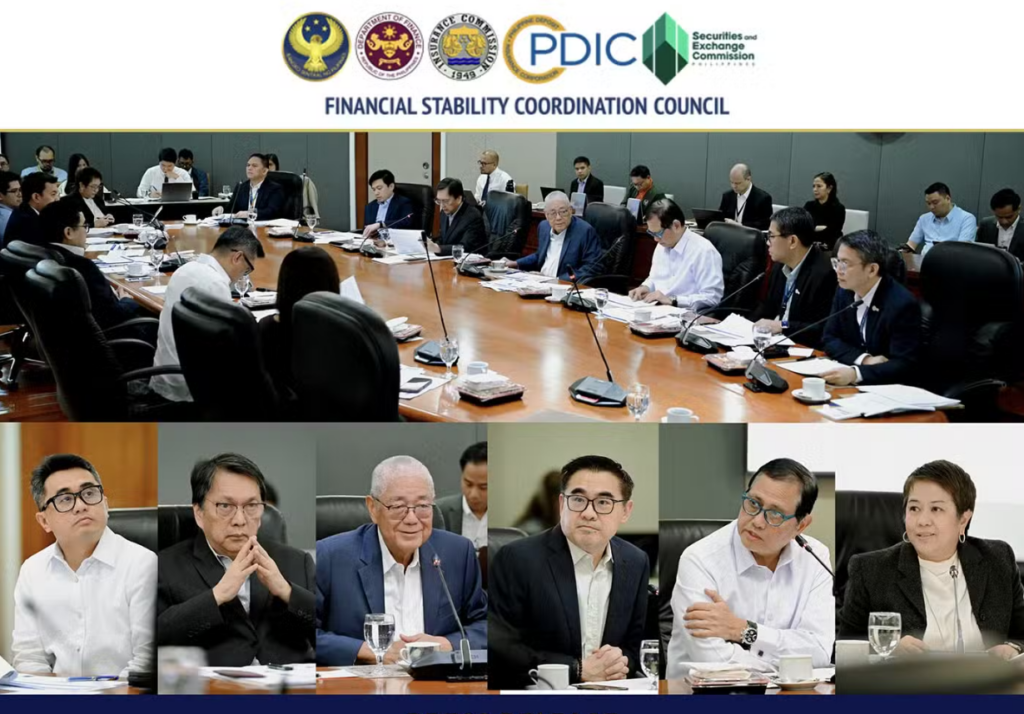
MAKATI CITY, Philippines — The Financial Stability Coordination Council (FSCC), composed of the country’s top financial regulators, has issued a “clean bill of health” for the Philippine financial system while simultaneously raising a red flag regarding concentration risk. In its latest systemic risk assessment for the second quarter of 2026, the council noted that while banks remain well-capitalized, the increasing exposure to a few large conglomerates and specific sectors could pose a vulnerability if global economic volatility intensifies.
The assessment comes at a delicate time for the local economy. With the Philippine Peso sliding beyond ₱60 vs $1 and the “diesel double whammy” driving up operational costs, regulators are keeping a close eye on the “interconnectedness” of the country’s biggest business players. The FSCC—which includes the Bangko Sentral ng Pilipinas (BSP), the Department of Finance (DOF), and the Securities and Exchange Commission (SEC)—emphasized that the system’s current strength should not lead to complacency.
“Our banks have healthy buffers and a high Liquidity Coverage Ratio (LCR),” a BSP official stated during the FSCC briefing. “However, we are noticing a high concentration of loans and investments in a handful of massive conglomerates that span multiple industries—from energy and infrastructure to retail. If one major pillar faces a liquidity crunch due to external shocks, the ripple effect across the banking sector could be significant.”
The FSCC’s “Risk Heat Map” for 2026 identifies several areas requiring heightened monitoring:
- Conglomerate Exposure: Many of the country’s top banks belong to the same parent companies as the firms they lend to. Regulators are looking at stricter “Single Borrower Limits” to prevent over-concentration in these “closed-loop” financial ecosystems.
- Infrastructure Sensitivity: With massive projects like the ₱50-billion housing initiative and DPWH highway repairs underway, a significant portion of the financial system’s assets are tied to long-term, high-capital projects that are sensitive to interest rate hikes and the weakening Peso.
- Energy Sector Volatility: As oil firms rush to build bigger fuel buffers amidst the Middle East conflict, the financing for these energy imports is placing a temporary but heavy demand on the domestic dollar supply.
- Real Estate Interdependence: Following the success of Rockwell Land’s ₱10-billion bond, regulators are monitoring the synergy between REITs (Real Estate Investment Trusts) and the banking sector to ensure that a localized property dip doesn’t trigger a broader credit contraction.
To address these risks, the FSCC is proposing a “Macro-Prudential” framework that encourages banks to diversify their portfolios toward the “Creative Economy” and the agricultural sector, particularly for solar-powered irrigation and other green-tech projects. By spreading risk across a wider variety of smaller, high-growth industries, the council believes the financial system can become more resilient to the “Third Wave” of global fallout.
Despite the warnings, the Philippine Stock Exchange (PSE) remains optimistic, recently maintaining its ₱170-billion capital raise target. Financial analysts suggest that the regulators’ “proactive flagging” is a sign of a maturing market that is better prepared for shocks than it was during previous global crises.
As the Amihan (Northeast Monsoon) fades and the summer heat intensifies, the FSCC’s message is clear: the foundation is solid, but the architecture of the financial system must become more diverse to withstand the unpredictable winds of the global economy.