
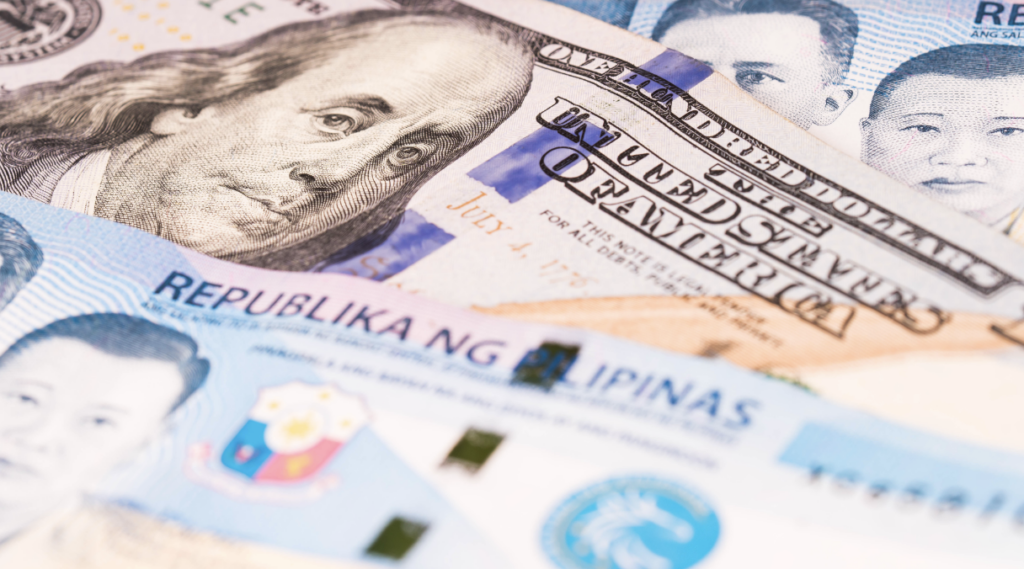
MANILA, Philippines — Sounding a sharp warning for local fiscal managers as a combination of aggressive domestic rate cuts and external geopolitical pressures threatens to weaken the national currency, one of global finance’s largest banking institutions has issued a highly bearish projection. Mitsubishi UFJ Financial Group (MUFG) has warned that the Philippine peso is at severe risk of spiraling down to a historic low of ₱64.10 against the US dollar.
The stark currency depreciation forecast serves as a crucial wake-up call for the Bangko Sentral ng Pilipinas (BSP) as it attempts to balance local economic growth against rapid capital flight.
According to MUFG’s macroeconomic strategy briefing, the primary driver behind the projected peso slide is a stark divergence in central banking trajectories between Manila and Washington:
                      [ THE INTEREST RATE DIVERGENCE FRACTION ]
                                         │
         ┌───────────────────────────────┴───────────────────────────────┐
         ▼                                                               ▼
   [ THE BSP DOVISH PIVOT ]                                        [ THE US FED HAWKISH MOAT ]
 • **The Action:** Faced with cooling domestic inflation and      • **The Action:** Grappling with a highly resilient labor
   slowing GDP indicators, the BSP has initiated a series of       market and stubborn wage growth, the US Federal Reserve
   aggressive interest rate cuts.                                  keeps its benchmark rates pinned at elevated levels.
 • **The Capital Flight:** This narrowing interest rate premium  • **The Outcome:** The high-yield environment turns the US dollar
   erodes the yield advantage of local peso-denominated bonds,     into an absolute magnet for global capital, aggressively
   prompting foreign funds to rapidly liquidate their holdings.   pulling investment dollars away from emerging markets.
MUFG’s research team highlighted that the currency’s vulnerabilities are further exacerbated by structural weaknesses within the Philippines’ external accounts:
[ THE TRIPLE-THREAT DEPRECIATION LOOPS ]
                  │
                  ▼
[ Chronic Trade Deficit Expansion ] ──► Heavy import dependency for industrial infrastructure inputs and agricultural
                                        shortfalls continues to drain the country's dollar reserves.
                                        │
                                        ▼
[ Global Crude Oil Volatility ]     ──► Renewed geopolitical flare-ups in energy corridors push international crude prices
                                        higher, forcing local importers to buy expensive dollars to settle fuel shipments.
                                        │
                                        ▼
[ Remittance Cushion Compression ]  ──► While Overseas Filipino Worker (OFW) cash inflows remain steady, the structural
                                        volume is no longer large enough to offset the massive trade deficit.
A steep slide toward the ₱64.10 horizon carries severe macroeconomic consequences for local consumers and corporate balance sheets alike.
| Macroeconomic Vector | The Immediate Risk | The Downstream Economic Impact |
| Consumer Retail Matrix | A weaker peso instantly spikes the cost of imported fuel, electricity generation, and staple grains. | Triggers a secondary wave of “imported inflation,” erasing the purchasing power gains achieved by workers. |
| External Debt Servicing | The government’s multi-billion dollar foreign debt portfolio automatically balloons in peso terms. | Forces fiscal managers to redirect a larger portion of the national budget toward debt service, starving vital infrastructure projects. |
| Corporate Margins | Local manufacturers relying on foreign raw materials face sharply escalating input costs. | Compels companies to scale back expansion plans, potentially chilling the local job market. |
While some local exporters and OFW families benefit briefly from a higher dollar conversion rate, economists warn that a chaotic, unmitigated breach of the ₱60-threshold can trigger a severe crisis of confidence across local equity and bond markets. To defend the currency, the BSP is expected to heavily deploy its Gross International Reserves (GIR) for tactical spot-market interventions. However, MUFG’s stark projection underscores that if the global interest rate environment remains unyielding, the local currency faces a steep uphill battle through the remaining quarters of the year.