
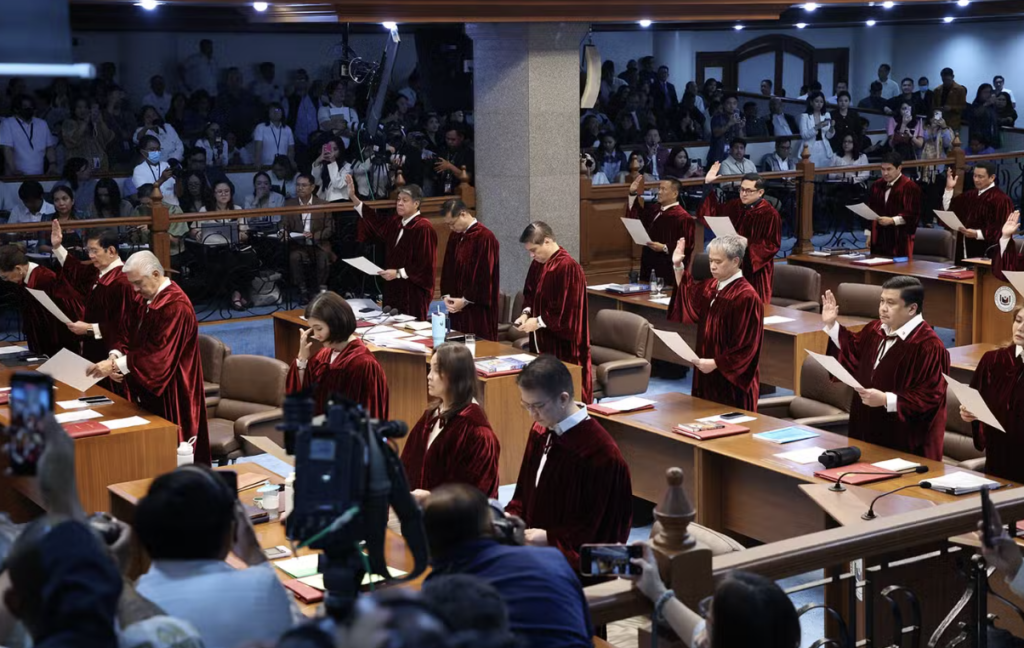
MANILA, Philippines — Issuing a sharp warning against political theater in the upper house, the country’s most influential corporate leaders are demanding a fair and completely transparent constitutional process. Prominent business groups have jointly issued a pointed appeal to senators to set aside raw partisan interests as they prepare to act as judges in the impeachment trial of Vice President Sara Duterte.
The Makati Business Club (MBC) and the Management Association of the Philippines (MAP) released separate statements calling the upcoming proceedings one of the Senate’s most significant constitutional mandates—and a critical opportunity to restore eroded institutional credibility.
The direct intervention from the business community comes on the heels of a highly volatile period within the upper chamber that has deeply unnerved both foreign and local observers:
[May 11, 2026: House Ouster Vote] ──► Transmits 4 Articles of Impeachment vs Vice President
                                                 │
                                                 ▼ (The Senate Shock wave)
[Abrupt Leadership Takeover]         ◄── Senator Alan Peter Cayetano Installed as Senate President
                                                 │
                                                 ▼
                        [Business Sector Issues Direct Integrity Warnings]
In a statement dated May 24 but released publicly on Monday, the MBC explicitly cited the “unprecedented drama and chaos” that unfolded within the legislative halls earlier this month. The MAP echoed these concerns, stating that a sudden leadership coup—which saw Senator Vicente Sotto III abruptly unseated by Cayetano—has placed the institution “at a difficult moment, amid deep political divisions.”
The business groups did not mince words, explicitly placing the burden of institutional honor on the shoulders of the newly installed Senate leadership:
“The Makati Business Club respectfully reminds all our Senators that you were elected by the people to serve the people and not pursue personal, political or business interests… If the public perceives the Senate President as purely partisan, does not possess the necessary independence and moral ascendancy, public confidence in the institution is eroded.” — Makati Business Club Official Statement
                            [ IMPEACHMENT COURT TIMELINE & BENCHMARKS ]
                                                 │
         ┌───────────────────────────────────────┴───────────────────────────────────────┐
         ▼                                                                               ▼
   [ PROCEDURAL REALITY ]                                                          [ CRITICAL CONVICTION METRICS ]
   • The Senate officially convened as an impeachment court on **May 18**.          • A two-thirds majority (**16 out of 24 senatorial votes**)
   • The formal trial proper is scheduled to open on **July 6**.                     is legally required to convict and remove the VP.
   • The business umbrella warns against any premature backroom deals             • Proceeding with the trial is framed as an essential path
     or an outright administrative dismissal without a trial.                        for the Vice President to legally clear her name.
The primary driver behind the private sector’s sudden public stance is the direct threat of economic destabilization. Leaders from the Federation of Philippine Industries (FPI) and the Financial Executives Institute of the Philippines (FINEX) warned that the country’s macro-economic health is intrinsically tied to the stability of its democratic processes.
| Private Sector Risk Analysis | Institutional Impact Matrix | Core Economic Warning |
| Rule of Law Degradation | Occurs when constitutional mandates appear subordinate to short-term political survival and factional infighting. | Drives away foreign direct investment (FDI) and compromises long-term sovereign credit ratings. |
| Market Predictability | Depends on transparent, credible public institutions enforcing uniform compliance without bias. | Paralyzes domestic capital expenditure when state accountability structures fracture. |
Vice President Duterte faces four severe articles of impeachment, including allegations that she systematically misused office confidential funds, bypassed state procurement guidelines, accumulated unexplained wealth, and publicly orchestrated a death threat scheme against President Ferdinand Marcos Jr. and top legislative leaders.
As the Senate prepares for the July trial, the business community’s message remains absolute: history will judge the chamber not by its political allegiances, but by its fidelity to the Constitution.