
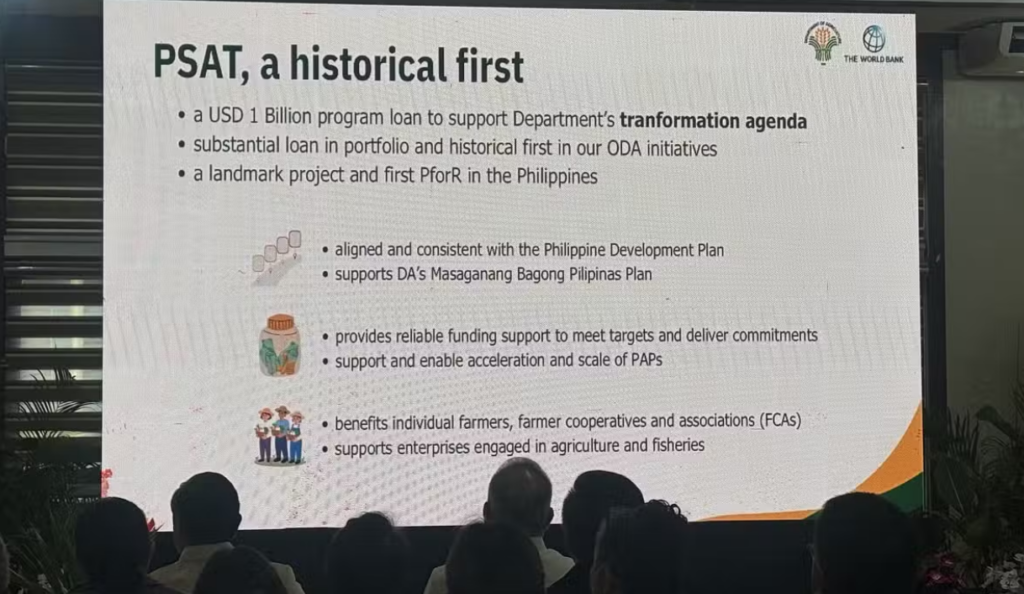
MANILA, Philippines — In a historic move to modernize the country’s aging food production systems, the Department of Agriculture (DA) and the World Bank have officially launched a massive $1-billion (approximately ₱58.5-billion) collaborative initiative. The massive funding package marks the single largest investment in the history of Philippine agriculture, designed to fundamentally transform the sector from survival-mode farming into a highly competitive, climate-resilient industry.
The initiative expands and scales up the highly successful Philippine Rural Development Project (PRDP) into a multi-year national master plan titled PRDP Scale-Up.
Moving away from localized, piecemeal assistance, the $1-billion program shifts the country toward a highly structured, macro-level approach to food security:
- Agricultural Enterprise Clusters: Funding will be heavily directed toward developing regional “enterprise clusters.” Instead of supporting isolated farms, the DA will finance interconnected networks of farmers, fishers, and suppliers working across entire provinces to achieve economies of scale.
- Complete Value Chain Integration: The roadmap expands the focus from simple harvest production to high-value post-harvest processing, specialized packaging, cold-chain logistics, and direct, middleman-free market access.
1. Climate-Resilient Rural Infrastructure
With the country grappling with severe weather anomalies in 2026—including “danger category” heat indexes and shifting monsoon patterns—the infrastructure push focuses on extreme durability:
- All-Weather Farm-to-Market Roads (FMRs): Constructing climate-proof, concrete road networks designed to withstand severe seasonal flooding and typhoons, ensuring vital food corridors remain open during disasters.
- Modern Post-Harvest Facilities: Building temperature-controlled warehouses, solar bubble dryers, modern rice mills, and state-of-the-art cold-storage facilities to systematically address food preservation challenges.
2. Digitalization and Technical Modernization
A significant portion of the World Bank loan is earmarked for introducing advanced data-driven systems to agrarian reform beneficiaries and cooperatives:
- Precision Agriculture: Deploying satellite imaging, automated soil mapping, and precision drone technologies to help farmers optimize fertilizer application and maximize crop yields.
- Digital Credit & Insurance Lines: Integrating digital financial systems so smallholder farmers can quickly apply for crop insurance and modern equipment loans without bureaucratic delays.
| Focus Area | Pre-Transformation Baseline | Post-Expansion Target (2028) |
| Post-Harvest Loss | Estimated 15% to 20% waste in staples. | Targeted reduction below 8% group-wide. |
| Average Farmer Income | Stagnant due to reliance on middlemen. | Projected 30% increase via direct-to-market supply chains. |
| Infrastructure Reach | Localized barangay dirt roads. | Inter-provincial, climate-proof economic corridors. |
Agriculture Secretary Francisco Tiu Laurel Jr. and World Bank representatives emphasized that this partnership serves as a critical countermeasure against cheaper food imports from neighboring ASEAN giants like Vietnam and Thailand.
By heavily subsidizing infrastructure and modernizing equipment, the program aims to systematically lower the local per-kilogram production cost of essential staples—such as rice, corn, fisheries, and livestock—making high-quality Filipino produce highly competitive both in local supermarket aisles and global export markets.