
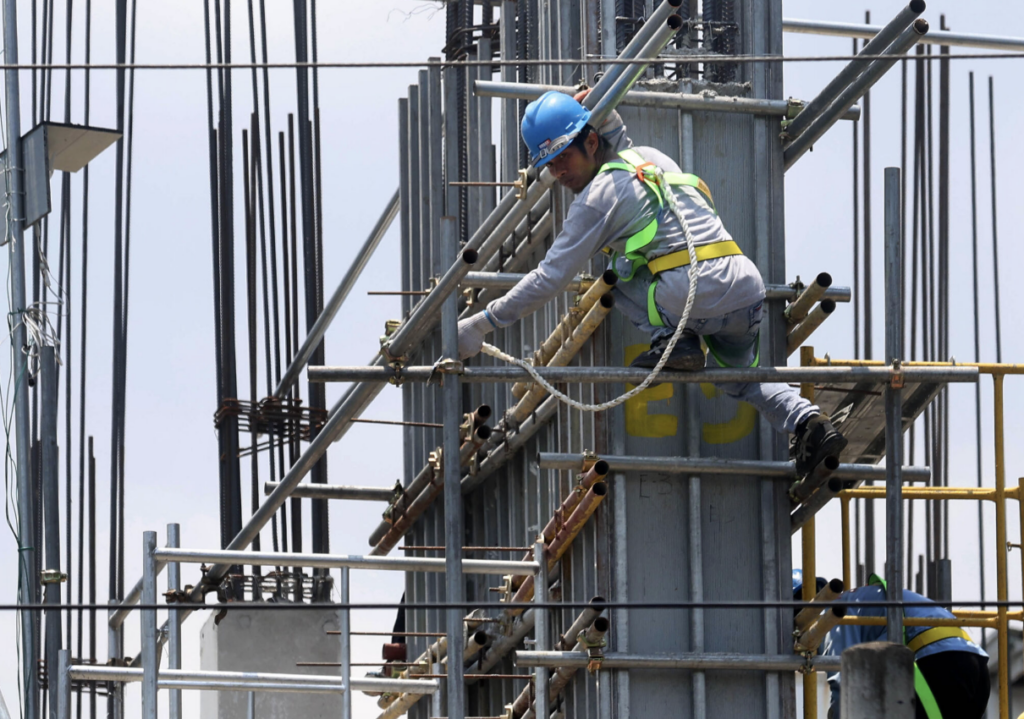
MANILA, Philippines — Even as the Marcos administration experiences a broader fiscal rebound in overall state disbursements, its core builder sectors remain heavily bogged down. National infrastructure spending suffered an aggressive contraction in April, extending a nearly year-long slowdown triggered by heightened institutional oversight.
Latest data from the Department of Budget and Management (DBM) shows that infrastructure and other capital outlays plunged 52 percent to ₱41.5 billion in April, down from ₱85.8 billion recorded in the same month last year.
The severe drop-off marks the 10th consecutive month of year-on-year declines for the sector. The long-term construction slowdown traces its roots directly to the fallout from a multi-billion-peso flood control corruption scandal that rocked state infrastructure departments last year:
                         [ THE CAPITAL OUTLAY CONTRACTIVE CRUNCH ]
                                             │
         ┌───────────────────────────────────┴───────────────────────────────────┐
         ▼                                                                       ▼
   [ THE REVENUE REVERSAL ]                                              [ THE 4-MONTH CUMULATIVE LOSS ]
 • **April Outlays:** **₱41.5 Billion** *(Down 52% vs. April 2025's     • **Jan-Apr 2026 Aggregate:** Total capital spending dropped
   ₱85.8 Billion portfolio)*.                                         • **45.6 percent to ₱189.3 billion**, compared to the
 • **The Validation Bottleneck:** The DBM noted that the slump was   • ₱347.6 billion deployed during the same period last year.
   driven entirely by slow releases at the Department of Public Works• **Stranded Budgets:** The severe contraction persisted despite
   and Highways (DPWH), where progress billings and payment claims   • the DPWH securing a massive ₱72.1 billion allotment allocation
   face grueling, multi-layered structural validation checks.       • from the 2026 national budget in April alone.
“The turnaround time for processing of payments was extended due to review procedures,” the DBM explicitly noted, clarifying that while physical construction on prior-year projects continues on the ground, the velocity of capital distribution has completely slowed under tighter, newly implemented anti-graft auditing frameworks.
The deep freeze gripping infrastructure pipelines stands in sharp contrast to a robust, double-digit recovery tracking across the wider national balance sheet. Total national government disbursements climbed 11.1 percent to ₱505.4 billion in April, up from ₱454.8 billion a year earlier:
[ THE APRIL DISBURSEMENT PROFILE ]
                    │
                    ▼
[ Strongest Pivot ] ──► The 11.1 percent expansion represents the state's most aggressive spending clip since
                        March 2025, breaking a long string of flat or negative monthly turnouts.
                        │
                       ▼
[ Operational Boost ]──► According to the DBM, the non-infrastructure expansion was driven by a wave of higher
                        subsidy supports injected directly into state-run government corporations.
                        │
                        ▼
[ Primary Anchors ] ──► Rapid budget processing across **Personnel Services (civilian salaries), interest payments,
                        and automated transfers to Local Government Units (LGUs)** insulated the broader cash flow.
The government’s persistent spending bottleneck is already sending heavy financial ripples across the country’s broader industrial ecosystem. In a parallel industry review, the Cement Manufacturers Association of the Philippines (Cemap) confirmed it has officially abandoned its early-year growth expectations for 2026, steering its projections toward a single-digit contraction instead.
Because public sector infrastructure projects traditionally devour roughly 40 percent of total domestic cement volumes, building material firms noted that even the optimal dry-season construction window (spanning February to April) failed to generate a typical demand spike. While procurement teams hope that the strict validation queues will normalize heading into the second half of the year, material suppliers, real estate analysts, and commercial contractors are keeping a highly cautious outlook as tighter administrative bottlenecks alter the rollout timelines of the administration’s flagship transport and utility projects.