
MANILA, Philippines — As the Philippines reels from skyrocketing energy costs triggered by global geopolitical tensions, energy economists suggest that stronger, earlier investments in renewable energy—specifically geothermal power—could have significantly cushioned the economy. With electricity prices in the Wholesale Electricity Spot Market (WESM) surging by 52.5 percent in April 2026, the country’s heavy reliance on imported fossil fuels has left Filipino consumers highly vulnerable to external price shocks.
Current projections from the Department of Energy (DOE) see diesel prices reaching as high as ₱230 per liter and gasoline hitting ₱175 per liter following recent military actions in the Middle East.
University of the Philippines School of Economics professor Karl Robert Jandoc highlighted that while solar and wind are intermittent, geothermal energy provides critical “baseload” capacity, meaning it can generate electricity 24 hours a day.
- Domestic Stability: Expanding geothermal capacity earlier would have reduced the need for imported coal, which currently dominates the energy mix at 62.5 percent.
- Pass-Through Costs: Because oil is required to transport and produce coal and gas, rising oil prices lead to higher electricity costs. A domestic renewable source like geothermal bypasses these logistical price hikes.
- Current Gap: Despite its potential, geothermal energy currently accounts for only 9.1 percent of the national power grid, despite the Philippines being the world’s third-largest producer of geothermal energy.
One major hurdle to geothermal expansion has been the high upfront cost and the financial risk of drilling wells that may not be viable. To address this, the DOE and Department of Finance have launched the Philippine Geothermal Resource De-Risking Facility (PGRDF):
- The Fund: Backed by a $170-million sovereign loan from the Asian Development Bank (ADB).
- Exploration Loans: Landbank will provide loans covering up to 50 percent of exploration costs.
- The Guarantee: If a developer succeeds, they repay the loan; if the exploration fails, the loan is converted into a government grant, significantly lowering the barrier for private investment.
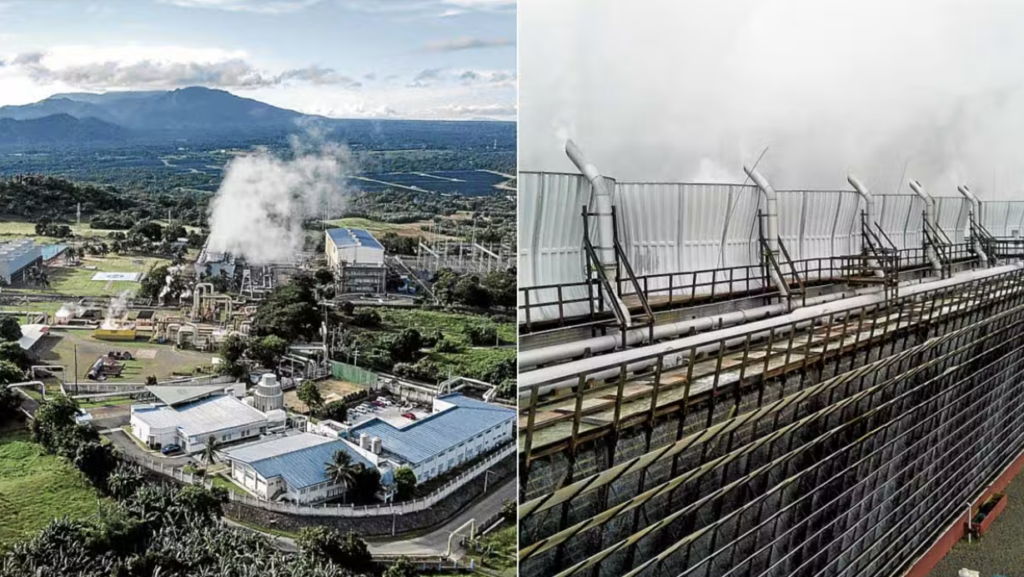
Aboitiz Renewables, a key player in the sector, currently provides 307 megawatts of capacity to the Luzon grid through its Makiling-Banahaw (MakBan) and Tiwi facilities.
- Operational Reliability: The company reported a 95 percent availability factor over the last three years, demonstrating the stability of geothermal power.
- Technological Innovation: Aboitiz operates binary plants that harness residual heat from geothermal fluids in a closed-loop system, increasing efficiency.
- Community Impact: Beyond energy, the company supports local initiatives such as the Kabamboohayan Project for the Higaonon tribe in Bukidnon and AI data annotation training for stay-at-home mothers in rural areas.
DOE Undersecretary Rowena Cristina Guevara noted that the prescription to move toward renewables was made as early as the 1973 oil crisis. However, historical roadblocks—primarily the high cost of early green technologies—delayed the transition. With the current crisis laying bare the risks of energy dependence, the shift toward a less carbon-intensive and more localized power system is no longer just an environmental goal, but a matter of national economic security.